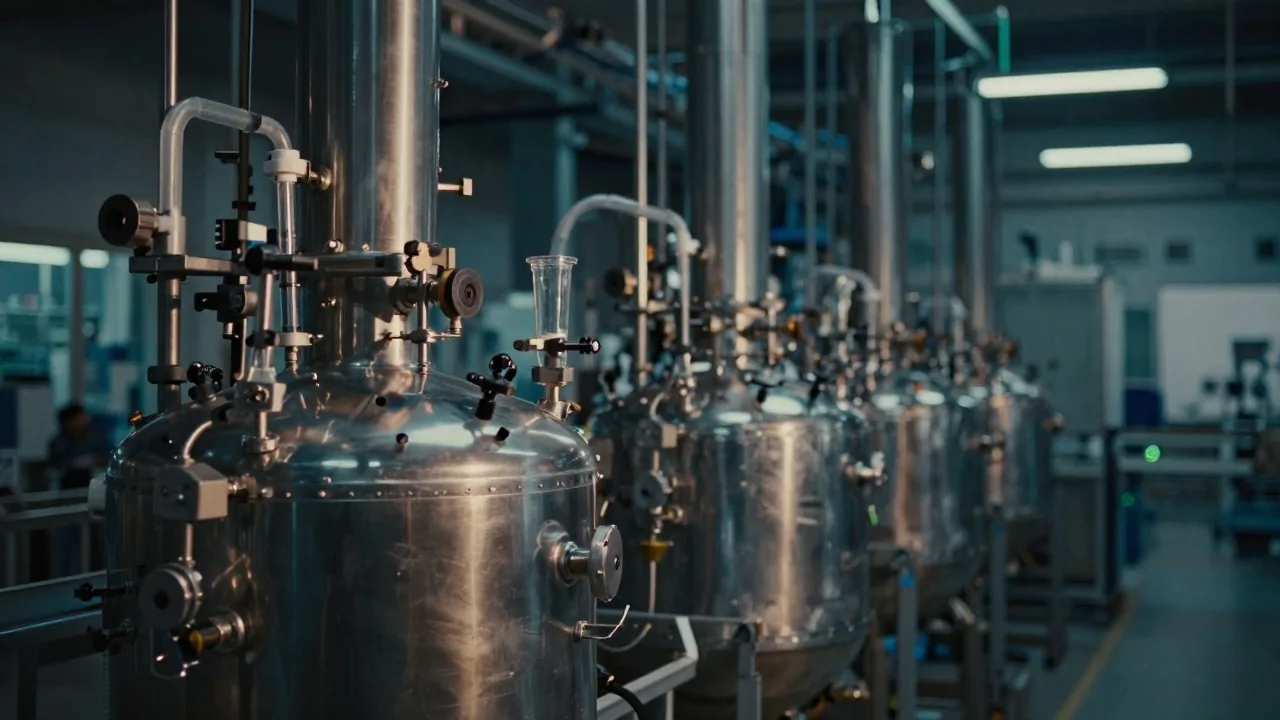
Continuous manufacturing in pharmaceuticals is no longer a research initiative. By the start of 2026, more than thirty FDA-approved products use continuous processes for at least one manufacturing step, ICH Q13 has been final for over three years, and the FDA’s Emerging Technology Program - set up in 2014 to lower the regulatory friction for novel manufacturing approaches - has worked with most of the major manufacturers.
What the technology is not, despite the headline products, is widely adopted. The adoption pattern is bimodal: a small group of large manufacturers running continuous lines for selected products, and a much larger group still operating purely batch. The interesting question for 2026 is why.
What’s been approved
The first continuous manufacturing approval cited by the FDA is generally Vertex Pharmaceuticals’ Orkambi, approved in 2015. Subsequent approvals have included Janssen’s Prezista, Pfizer’s Daurismo, and a list of other oral solid dosage products from Eli Lilly, Merck, and contract manufacturers. The technology has expanded beyond oral solid dosage into biologics - perfusion bioreactors with continuous capture chromatography are now in commercial production at multiple sites.
The list is short relative to the total number of approvals over that decade, but it includes high-volume products from major manufacturers. The stigma question - will regulators accept this? - has been answered.
Where the technology has stuck
Three production contexts have produced clear continuous-manufacturing wins:
Oral solid dosage with stable formulations. A continuous direct-compression line that runs the same product for years amortizes the capital investment and the validation cost across enough batches to make the economics work. Most public approvals fit this profile.
Biologics with long campaigns. A perfusion bioreactor with continuous capture chromatography reduces the size of the bioreactor, the volume of media, and the number of buffer-prep operations. For products with high titer requirements and long campaigns, the savings are material.
Active pharmaceutical ingredient flow chemistry. Continuous flow synthesis, especially for hazardous chemistries, has been adopted in selected API manufacturing. The driver here is often safety, not productivity - running an exothermic reaction in a small flow reactor is materially safer than running it in a 5,000-litre vessel.
Where it has not
The bottleneck is not regulatory. ICH Q13 settled the regulatory mechanics; the FDA Emerging Technology Program offers a clear path for novel proposals; the CDER and CBER have shown they will approve continuous processes when the data supports it.
The bottleneck is organizational. Three patterns recur in projects that stall:
First, capital-allocation logic. Continuous lines require new equipment, new automation, and new validation. The capital request competes with debottlenecking projects on existing batch lines, where the ROI calculation is more straightforward and the team running the calculation is the same team running the existing batch facility.
Second, workforce mismatch. Continuous manufacturing demands engineers and operators who are comfortable with control loops, real-time data, and statistical process control - not the QC analyst-batch-record workflow that defines a generation of pharmaceutical manufacturing staff. Hiring and training for the gap takes years.
Third, product-mix friction. A continuous line excels when running one product for long campaigns. A site running thirty SKUs through shared equipment, with frequent changeovers and small lots, is a poor fit. The economics of continuous and the economics of contract manufacturing for branded generics often pull opposite directions.
What’s changed in the last 18 months
Two shifts have moved noticeably between 2024 and early 2026.
The first is in biologics. Continuous downstream - capture, viral inactivation, polishing chromatography - has matured from an academic and demonstration topic to a routine option in tech transfer. The supply chain of single-use chromatography skids, in-line analyzers, and process control software is now adequate to support production-scale deployment, where five years earlier it was not.
The second is in small-molecule generics. The economics of continuous direct compression for high-volume generics are crossing into clear positive territory at multiple contract manufacturers, driven primarily by labor cost and yield improvements. This is a quiet shift but it changes the addressable market for continuous-line equipment vendors materially.
What to watch
Three indicators worth tracking through the rest of 2026:
- Number of continuous-manufacturing tech transfers between contract manufacturers - a leading indicator that the technology is replicable, not bespoke.
- Process analytics vendor revenue mix between batch and continuous - vendors disclose this unevenly, but earnings calls give signal.
- Hiring patterns at major manufacturers for continuous-process engineers - LinkedIn and trade-publication job listings are a reasonable proxy.
The technology is real. The adoption rate, three years into ICH Q13, is the real story.